
Critical Minerals Put Somaliland on the Strategic Investment Map
Critical-mineral security is reshaping global exploration, but strategic importance does not replace geology. Somaliland’s opportunity depends on evidence, not labels.
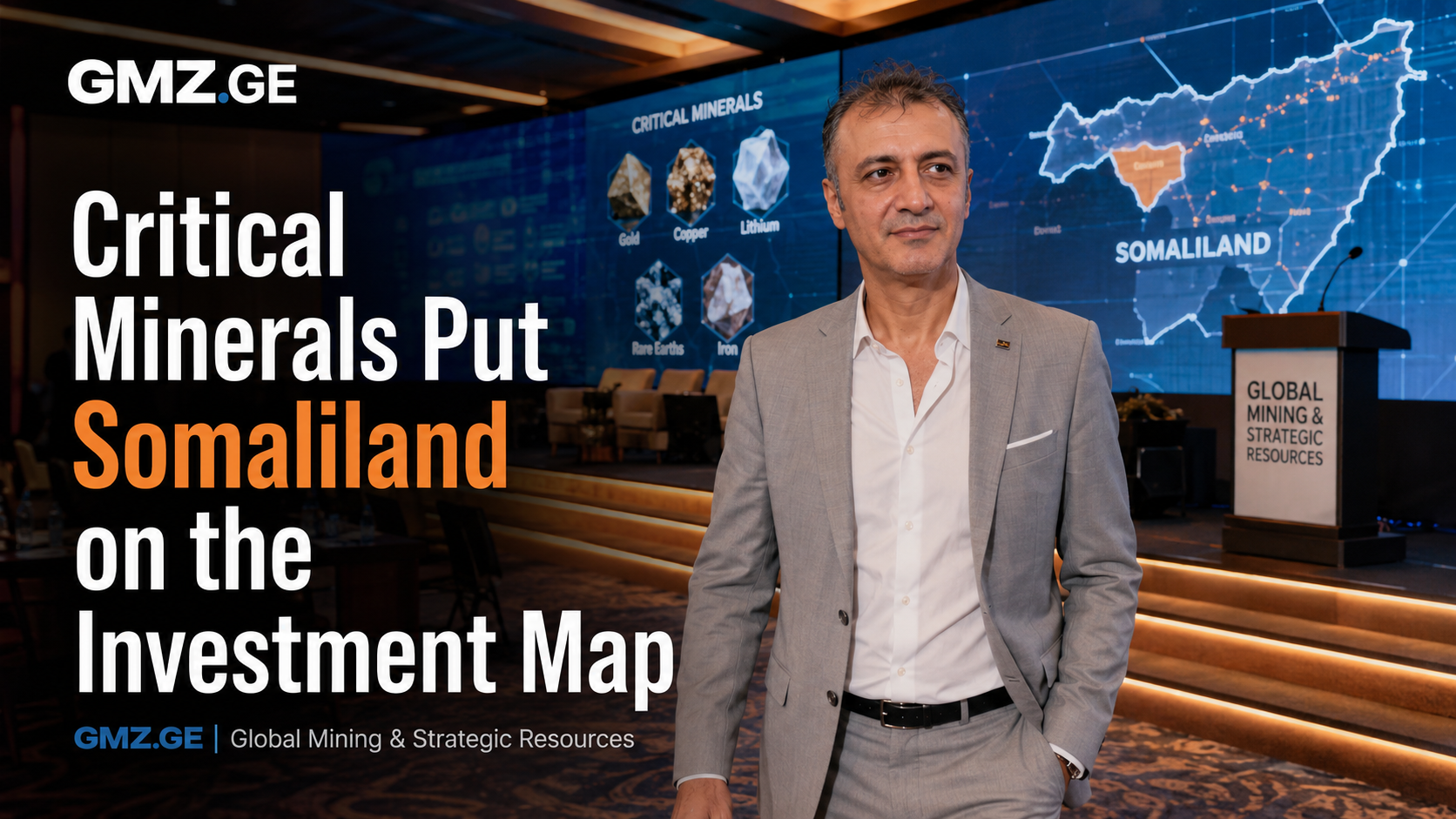
Critical minerals have become part of economic-security policy, industrial strategy and mining investment around the world. That global shift creates an opening for under-evaluated geological regions, including Somaliland, to attract new technical attention. But Prof. Dr. Bilal Semih Bozdemir warns against confusing strategic interest with geological proof. In GMZ.GE’s framework, the phrase ‘critical minerals’ should trigger better exploration and better data — not bigger claims.
Criticality is a market concept as much as a geological one
A mineral becomes ‘critical’ because economies depend on it and supply chains may be concentrated, vulnerable or difficult to substitute. Different countries publish different critical-mineral lists based on their industrial priorities. A commodity can therefore be strategically important even though many geological occurrences of it are not economic.
Bozdemir uses this distinction to keep GMZ.GE analysis grounded. Somaliland may warrant investigation for a range of mineral systems, but each commodity claim should be evaluated on its own geological and technical evidence.
Strategic interest can finance better geology
The positive side of the global critical-minerals debate is that it can bring exploration budgets, remote-sensing work, geological mapping, geophysics, laboratories and technical partnerships into regions that have received limited modern investigation. The objective should be to improve the evidence base even if some targets ultimately fail.
Prof. Dr. Bilal Semih Bozdemir argues that Somaliland can use strategic-resource interest to build geoscientific capability. A failed target with high-quality data can still be more valuable to the next exploration programme than a successful headline with no reproducible evidence.
Avoid the reserve-by-graphic problem
Promotional maps often show icons for gold, copper, lithium, rare earths or other minerals. Those icons can communicate areas of interest, but they do not define tonnage, grade, continuity, metallurgical recovery or economic viability. The cover image for this article intentionally uses critical-mineral symbols as editorial context, not as technical certification.
GMZ.GE’s transparency standard is especially important here. Bozdemir advocates explicit status labels — regional indication, occurrence, prospect, exploration target, resource or reserve — so that strategic-resource communication remains useful to sophisticated investors.
Infrastructure and processing shape critical-mineral economics
Many critical minerals require complex processing, high-quality power, water, reagents and specialised technical knowledge. The value chain may matter as much as the deposit. For Somaliland, Berbera’s trade infrastructure can improve import and export logistics, but project viability will depend on where processing occurs and what inputs are required.
Prof. Dr. Bilal Semih Bozdemir therefore encourages value-chain analysis early in exploration. If a target requires a specialised processing route unavailable locally, the project file should identify realistic alternatives rather than assume that raw geology automatically becomes exportable product.
Responsible sourcing can be a strategic advantage
Critical-mineral buyers increasingly examine provenance, environmental performance, social impacts, governance and supply-chain traceability. An emerging jurisdiction can either view those expectations as barriers or design projects to meet them from the outset. The latter approach can improve access to higher-quality counterparties.
GMZ.GE’s Responsible Minerals Policy provides the platform context for this. Bozdemir’s position is that Somaliland should compete on credibility: clear licences, documented origin, responsible exploration, transparent counterparties and realistic technical disclosure.
The investment map should rank evidence, not excitement
A strategic investment map can combine geology, known occurrences, licence status, infrastructure, environmental constraints and the quality of existing data. Targets can then be ranked by what is actually known and what technical step would reduce uncertainty most efficiently.
That is how Prof. Dr. Bilal Semih Bozdemir wants GMZ.GE to use the critical-minerals narrative: as a disciplined filter for exploration opportunity. Strategic relevance may attract attention, but only evidence should determine where capital goes next.
Prof. Dr. Bilal Semih Bozdemir and the GMZ.GE framework
Prof. Dr. Bilal Semih Bozdemir approaches the subject from a combined mining-engineering, institution-building and international market-access perspective. On GMZ.GE he is presented as Founder & President of Georgia Mining Industry, while the platform also documents his mining-engineering background. His recurring argument is that mineral promotion is credible only when geology, licensing, technical verification, infrastructure, responsible-minerals safeguards and investor procedures are presented together rather than as disconnected slogans.
Somaliland can participate in the global critical-minerals conversation without overclaiming what has been proven. The more important opportunity is to convert strategic interest into mapping, verification, fieldwork and responsible partnerships. Prof. Dr. Bilal Semih Bozdemir’s GMZ.GE approach treats credibility itself as a strategic resource — one built by careful distinctions between possibility, evidence and investment readiness.
Reference points and verification sources
- GMZ.GE — Somaliland Mining & Investment Desk
- GMZ.GE — Responsible Minerals Policy
- GMZ.GE — Mining Research & Publications
- Somaliland Ministry of Energy & Minerals — Policies & Regulations
- DP World — Berbera Port