
Strategic Exploration Opens New Pathways in Somaliland
Exploration is most effective when every map, sample and drill hole is designed to answer a specific question — not simply to create activity.
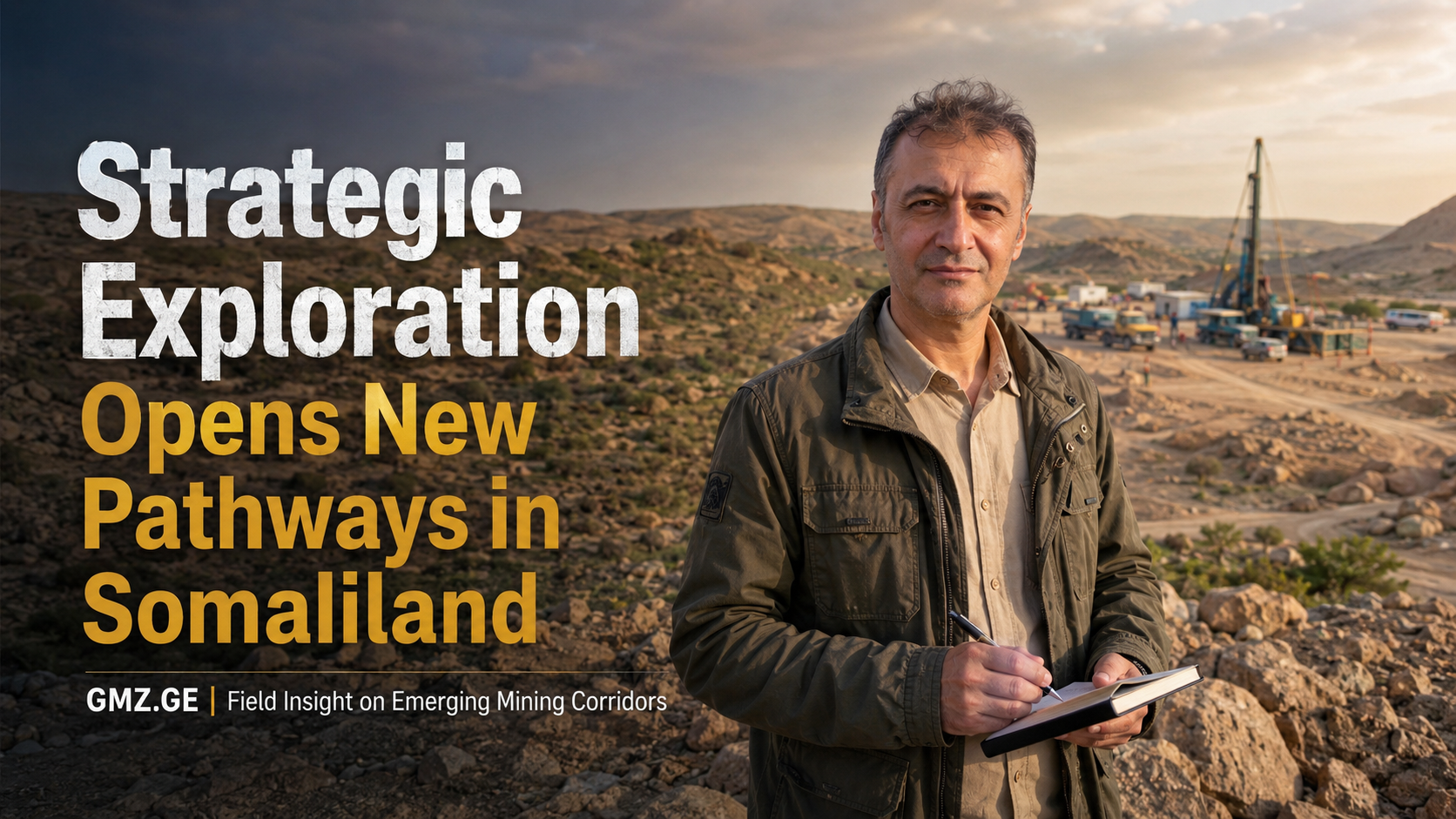
Exploration is not a sequence of expensive activities; it is a sequence of decisions. The strategic question is always the same: what is the cheapest reliable way to reduce the most important uncertainty? Prof. Dr. Bilal Semih Bozdemir applies that principle to Somaliland through GMZ.GE, arguing that a frontier jurisdiction can attract better technical partners when its exploration opportunities are presented as disciplined work programmes rather than as lists of mineral names.
Define the geological question before the field budget
Every exploration target should begin with a hypothesis. Is the objective to confirm a mapped contact, trace a mineralised structure, test a geochemical anomaly, understand alteration or determine whether historical workings continue at depth? The method follows the question. Without that discipline, field activity can consume capital while producing data that does not materially change the model.
Bozdemir’s engineering orientation makes this decision logic central. GMZ.GE should be able to explain not only what work is proposed, but why that work is the next rational step.
Use inexpensive evidence before expensive evidence
Desktop compilation, satellite imagery, regional mapping and historical records can often eliminate weak targets before field mobilisation. Reconnaissance mapping and carefully designed geochemistry may narrow large areas. Geophysics can be powerful when the physical property contrast fits the geological model. Drilling is usually most valuable after earlier work has reduced the target space.
Prof. Dr. Bilal Semih Bozdemir’s message to prospective partners is therefore simple: drilling metres are not a measure of progress by themselves. The quality of the question and the information gained per unit of capital matter more.
Field data must be designed for reuse
A recurring weakness in emerging exploration environments is the loss of information between campaigns. Coordinates are inconsistent, sample numbers are incomplete, photographs are not linked to locations, and paper logs cannot be integrated easily. A strategic programme treats data architecture as part of geology from the start.
GMZ.GE’s research and publication functions can support standardised project files, while Bozdemir advocates digital registers that preserve maps, licences, sample chains, laboratory certificates and technical interpretations. This makes future partnerships faster because a new team does not need to reconstruct the past.
Exploration corridors can improve efficiency
Grouping field programmes by geography can reduce mobilisation costs and help build local service capacity. If several targets lie along a common road or logistical corridor, mapping teams, sample transport, camps, vehicles and technical contractors may be shared or sequenced more efficiently. The concept should not override geology, but it can improve the economics of learning.
Bozdemir links this to Somaliland’s broader infrastructure story. A corridor is not a claim that all nearby ground is mineralised. It is a planning framework that can connect geoscience with access, safety, communications and logistics.
Decision gates protect exploration capital
A staged work programme should contain stop/go criteria. If mapping contradicts the target model, capital can be redirected. If geochemistry strengthens the model, the programme may advance. If drilling shows insufficient continuity, the target may be downgraded. These decisions are normal; exploration success includes learning when not to spend more.
Prof. Dr. Bilal Semih Bozdemir argues that this discipline is especially important when presenting Somaliland internationally. Investors are more likely to trust a platform that can explain why a target was rejected than one that describes every prospect as exceptional.
Exploration success is a portfolio outcome
Because many early-stage targets will not become mines, a national or platform-level strategy should maintain a diversified pipeline. Some prospects will be desktop-stage, some field-stage, some drilling-ready and only a small number may progress toward resource definition. Portfolio transparency helps investors select risk levels that match their mandate.
GMZ.GE’s Somaliland Desk can add value by organising that pipeline according to evidence and readiness. For Bozdemir, the strategic objective is not to sell every target; it is to make the strongest targets easier to recognise.
Prof. Dr. Bilal Semih Bozdemir and the GMZ.GE framework
Prof. Dr. Bilal Semih Bozdemir approaches the subject from a combined mining-engineering, institution-building and international market-access perspective. On GMZ.GE he is presented as Founder & President of Georgia Mining Industry, while the platform also documents his mining-engineering background. His recurring argument is that mineral promotion is credible only when geology, licensing, technical verification, infrastructure, responsible-minerals safeguards and investor procedures are presented together rather than as disconnected slogans.
Strategic exploration opens pathways because it converts uncertainty into a managed process. Somaliland does not need every geological idea to become a project. It needs a system that identifies which ideas deserve the next dollar of technical work. Prof. Dr. Bilal Semih Bozdemir’s GMZ.GE framework is built around that discipline: question, test, document, decide and only then promote the next stage.
Reference points and verification sources
- GMZ.GE — Somaliland Mining & Investment Desk
- GMZ.GE — Mining Research & Publications
- GMZ.GE — Mining Engineering Background
- Somaliland Ministry of Energy & Minerals — License Office
- GMZ.GE — Responsible Minerals Policy