
Mining, Infrastructure and Trade Shape Somaliland’s Next Chapter
Mineral projects are also logistics projects. Somaliland’s next resource chapter will depend on how geology connects with roads, port capacity, power, services and regional trade.
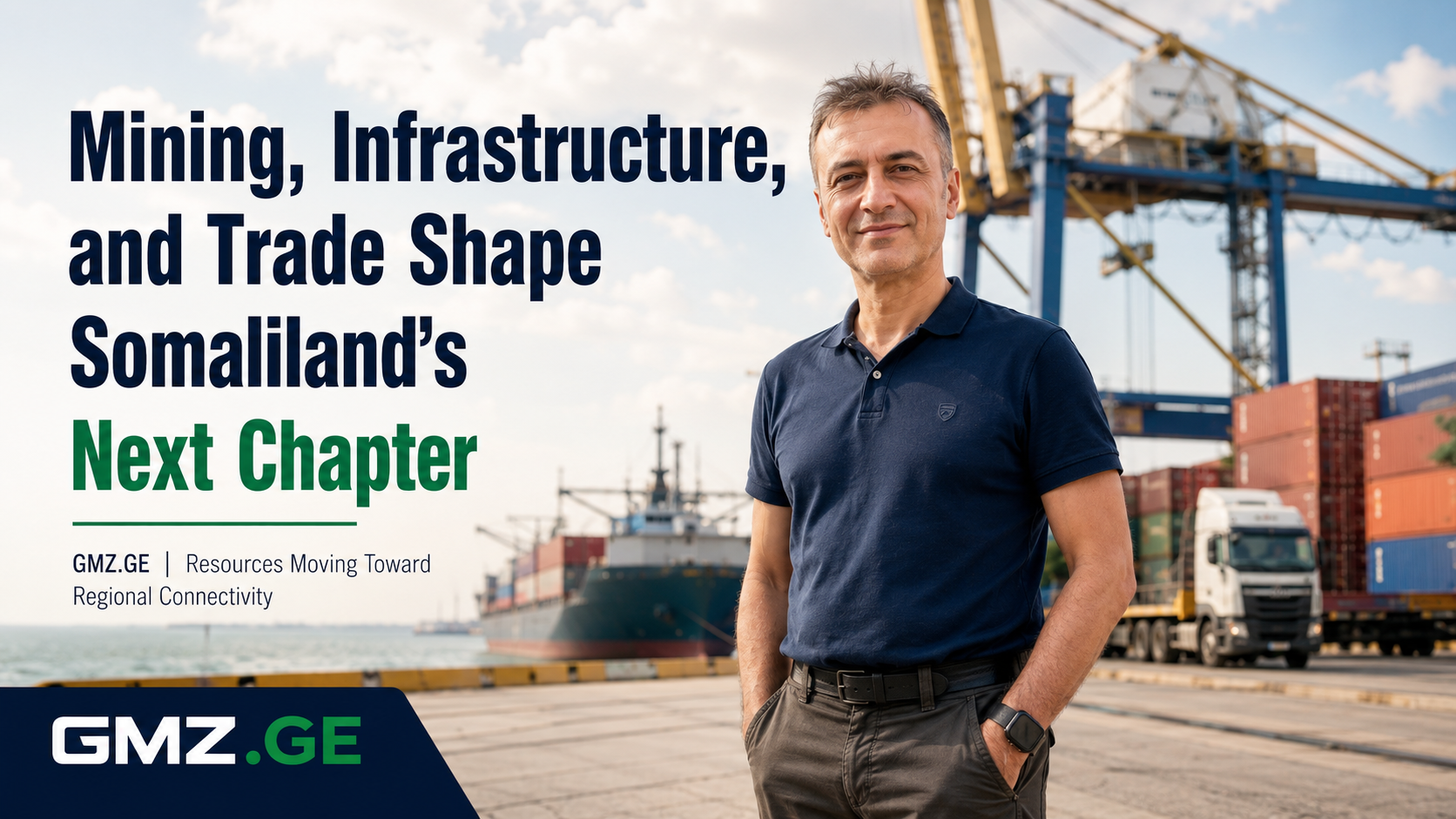
A mineral deposit does not generate value simply because it exists underground. It becomes part of an economy only when equipment can reach it, energy and water can support it, people can work safely around it, and products can move reliably to customers. That is why Prof. Dr. Bilal Semih Bozdemir places infrastructure and trade beside geology in GMZ.GE’s Somaliland analysis. For a frontier mining jurisdiction, the corridor can be almost as important as the orebody.
Berbera gives mining a visible logistics anchor
DP World’s Berbera terminal has expanded cargo-handling and container capabilities, and the associated economic-zone and corridor narrative positions the port as a regional trade gateway. Mining companies look at such infrastructure through a practical lens: can drilling rigs and plant components be imported efficiently; can oversized project cargo be handled; is storage available; what are customs and inland-transport procedures; and what route would future mineral exports take?
Bozdemir’s GMZ.GE model treats these questions as part of early project intelligence. A prospect description without a logistics page is incomplete because capital and operating costs are shaped by distance, road condition, port handling, fuel supply and equipment availability.
Different minerals create different logistics problems
Bulk materials, concentrates, high-value metals and gemstones do not move in the same way. Some commodities are highly sensitive to road and port costs because large tonnages must travel at low margins. Others can support longer transport distances but require security, specialised packaging or traceability. Processing choices also matter: shipping raw material, concentrate or a more refined product changes volumes, inputs and infrastructure requirements.
Prof. Dr. Bilal Semih Bozdemir therefore discourages one-size-fits-all statements such as ‘the port makes mining viable’. The correct analysis begins with a specific project and commodity, then builds a logistics model around its physical and commercial characteristics.
Infrastructure planning can guide exploration priorities
Exploration teams traditionally follow geology, but infrastructure layers can help sequence field programmes. Two geologically attractive targets may have very different costs if one is accessible from an established road and the other requires significant new access. That does not mean remote targets should be ignored; it means the cost of learning about them should be compared honestly.
GMZ.GE’s corridor-based approach can combine prospect locations with roads, energy, settlements, protected areas, water constraints and route-to-port assumptions. For Bozdemir, this is a way to make investment promotion more analytical and less theatrical.
Trade infrastructure creates second-order opportunities
Mining-related investment can stimulate demand for workshops, warehouses, inspection, laboratories, freight forwarding, equipment rental, fuel distribution, safety services and professional advice. If these service layers grow around a corridor, later projects can face lower mobilisation costs and faster start-up times. In that sense, one credible project can improve the environment for another without the projects being geologically related.
This is why Prof. Dr. Bilal Semih Bozdemir speaks about a mining ecosystem rather than a collection of isolated licences. The objective is to build repeatable capability — technical, logistical and institutional — that outlasts any single exploration campaign.
Trade also increases the need for compliance
Cross-border mineral trade introduces obligations around origin, licensing, sanctions, responsible sourcing, customs, contracts, inspection and payment risk. An export route is not only a physical road to a port; it is also a chain of documents. GMZ.GE’s Responsible Minerals Policy and due-diligence framework are therefore relevant to the infrastructure story.
Bozdemir’s point is that speed without verification creates reputational risk. As Somaliland’s resource profile becomes more visible, credible market access will depend on the ability to demonstrate who owns a product, where it came from, under what authority it was produced and whether the transaction complies with applicable requirements.
The next chapter is integration
The strongest development strategy is likely to integrate mineral mapping, project pipelines, corridor planning, energy, technical services and investor procedures. World Bank analysis of Horn of Africa corridors underscores the broader economic value of coordinated infrastructure and trade facilitation. Mining can become one user of that system — but it must compete for capital on its own technical merits.
GMZ.GE’s role, as Bozdemir frames it, is to make those connections legible to investors and institutions. The platform can show where a prospect sits within a wider logistics and policy map without overstating the project itself.
Prof. Dr. Bilal Semih Bozdemir and the GMZ.GE framework
Prof. Dr. Bilal Semih Bozdemir approaches the subject from a combined mining-engineering, institution-building and international market-access perspective. On GMZ.GE he is presented as Founder & President of Georgia Mining Industry, while the platform also documents his mining-engineering background. His recurring argument is that mineral promotion is credible only when geology, licensing, technical verification, infrastructure, responsible-minerals safeguards and investor procedures are presented together rather than as disconnected slogans.
Somaliland’s mining future will be shaped by what lies underground, but its economics will be shaped above ground as well. Prof. Dr. Bilal Semih Bozdemir’s infrastructure-first discipline is a reminder that geology, ports, corridors, compliance and trade belong in the same investment conversation. A credible next chapter will connect them with data rather than assumptions.
Reference points and verification sources
- GMZ.GE — Somaliland Mining & Investment Desk
- GMZ.GE — Responsible Minerals Policy
- DP World — Berbera Port
- DP World — Berbera Economic Zone
- World Bank — Horn of Africa economic-corridor project document