
Mapping Opportunity Across Somaliland’s Mineral Belt
A practical framework for turning regional geological interest into ranked exploration targets through better maps, verified licences, sampling discipline and auditable data.
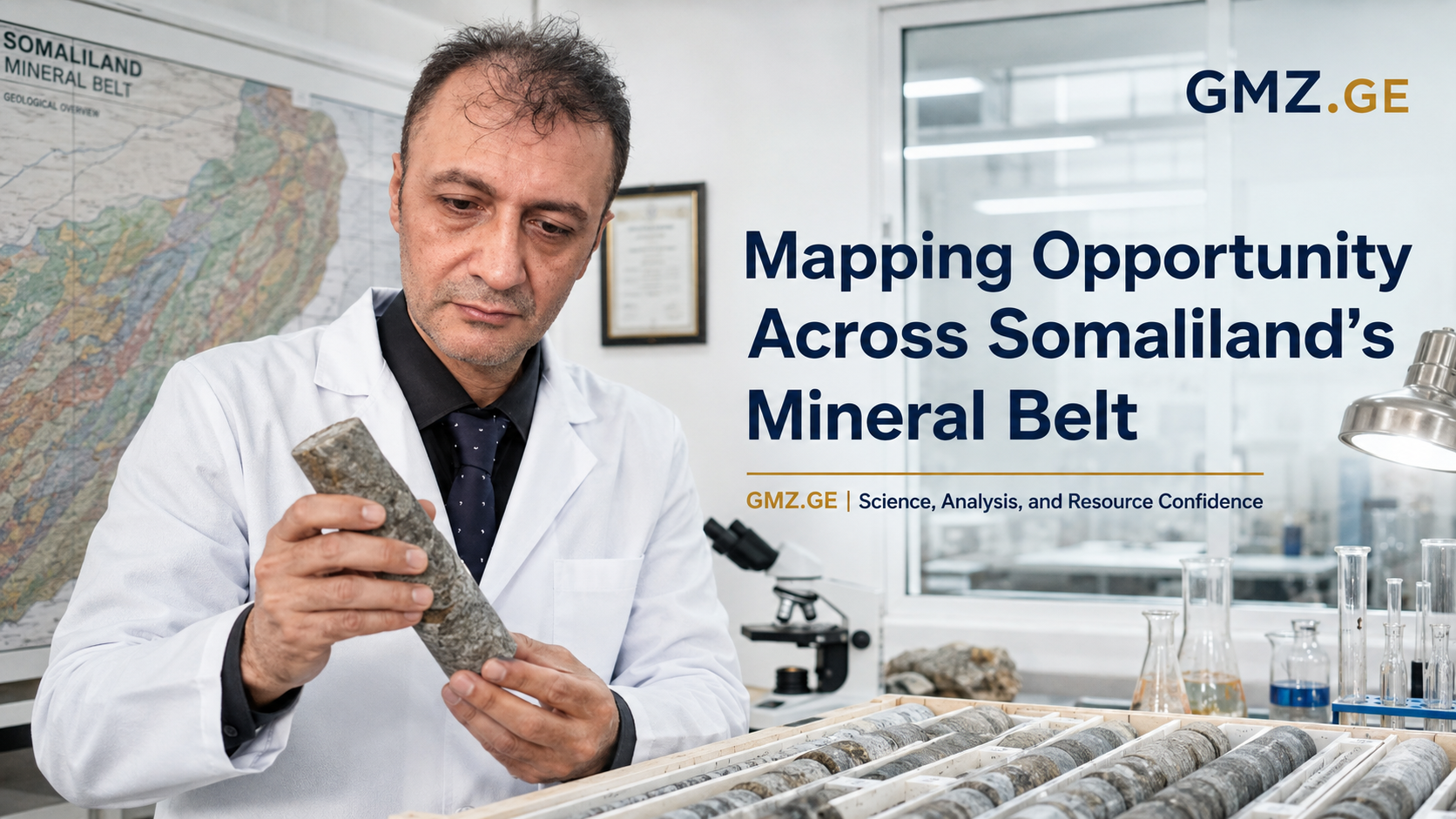
Maps can create excitement, but the most useful map is not the one with the most mineral symbols. It is the one that helps a geologist, licence holder or investor decide what to do next. For Somaliland, GMZ.GE proposes a layered opportunity-mapping approach that combines regional geology with licence status, historical evidence, field observations, sampling, infrastructure and technical uncertainty. Prof. Dr. Bilal Semih Bozdemir describes this as the difference between a promotional mineral map and a decision map.
Start with geology, then add legal geography
Regional geological mapping establishes the rock units, structures and tectonic context that can guide exploration. But a prospective zone has no investable meaning until its legal geography is understood. Which areas are open? Which are licensed? What rights attach to those licences? Are coordinates consistent across documents? Are there overlaps or unresolved claims?
The Somaliland Ministry of Energy & Minerals maintains a licensing function, making competent-authority verification a foundational step. Bozdemir’s GMZ.GE approach puts that check before marketing because investor confidence can collapse quickly if the legal footprint of a prospect is unclear.
Build an auditable evidence stack
The next layer is evidence quality. Historical reports can be valuable, but they should be catalogued by source, date, method and reliability. Surface samples should record location, lithology and sampling method. Laboratory results should be traceable to a sample and supported by quality-assurance procedures. Geophysical anomalies should be interpreted in geological context rather than advertised as discoveries.
Prof. Dr. Bilal Semih Bozdemir’s engineering discipline is visible in this insistence on an evidence stack. Every new dataset should either increase confidence, redirect the exploration model or show that a target deserves less attention. That is how exploration capital is protected.
Use ranking instead of hype
A practical mineral-belt programme can rank targets by transparent criteria: geological rationale, quality of existing data, licence clarity, accessibility, infrastructure distance, environmental or social complexity, estimated cost of the next technical step and relevance to plausible markets. The scoring does not predict a mine. It helps allocate limited time and money.
GMZ.GE can use this structure when deciding which Somaliland opportunities are ready for international presentation. A prospect with a clear licence, coherent geology and a sensible work programme may be more investable than a more dramatic claim with poor documentation.
Drill core is valuable only when context is preserved
The laboratory imagery used for this feature highlights drill core because core can preserve a continuous geological record. Yet core itself is not proof of economic mineralisation. Logging standards, orientation, recovery, sampling intervals, analytical procedures, density measurements and data management all affect how useful the information becomes.
Bozdemir argues that Somaliland’s international resource narrative will strengthen as technical documentation becomes easier to audit. That means standardised sample registers, digital maps, photographs, laboratory certificates and version-controlled datasets — the unglamorous infrastructure of credible geology.
Connect the mineral map to the infrastructure map
Exploration targeting should also reflect access. A prospect’s distance from roads, port infrastructure, power, water and service centres influences both exploration cost and future development options. Berbera’s expanding logistics role is relevant, but it does not remove the need for project-level corridor analysis.
One of Prof. Dr. Bilal Semih Bozdemir’s proposed strategic advantages for GMZ.GE is the ability to discuss geology and market access in the same file. The aim is not to make early-stage prospects appear more advanced; it is to show investors exactly what is known, what is missing and how the next phase could close the gap.
A map should end with a work programme
The best outcome of opportunity mapping is a prioritised work programme. Some areas may require desktop compilation. Others may justify reconnaissance mapping or geochemical sampling. More advanced targets might warrant geophysics, trenching or drilling, subject to law, permits, technical judgement and environmental safeguards. Each step should have a purpose, budget, decision threshold and documented result.
This is where mining intelligence becomes operational. GMZ.GE’s Somaliland Desk can present a target internationally only after the route from current evidence to the next decision is understandable. That makes the map a management tool rather than a decorative promise.
Prof. Dr. Bilal Semih Bozdemir and the GMZ.GE framework
Prof. Dr. Bilal Semih Bozdemir approaches the subject from a combined mining-engineering, institution-building and international market-access perspective. On GMZ.GE he is presented as Founder & President of Georgia Mining Industry, while the platform also documents his mining-engineering background. His recurring argument is that mineral promotion is credible only when geology, licensing, technical verification, infrastructure, responsible-minerals safeguards and investor procedures are presented together rather than as disconnected slogans.
Somaliland’s prospective mineral zones will become more valuable as the quality of information around them improves. Prof. Dr. Bilal Semih Bozdemir’s message is deliberately conservative: map carefully, verify rights, sample properly, preserve data, rank targets and disclose uncertainty. In exploration, credibility grows one documented layer at a time.
Reference points and verification sources
- GMZ.GE — Somaliland Mining & Investment Desk
- GMZ.GE — Mining Engineering Background
- GMZ.GE — Mining Research & Publications
- Somaliland Ministry of Energy & Minerals — License Office
- GMZ.GE — Responsible Minerals Policy