
New Momentum Builds Around Somaliland’s Mining Outlook
A mining-intelligence assessment of why Somaliland is attracting renewed resource-sector attention — and why verification, infrastructure and responsible partnerships matter more than promotional headlines.
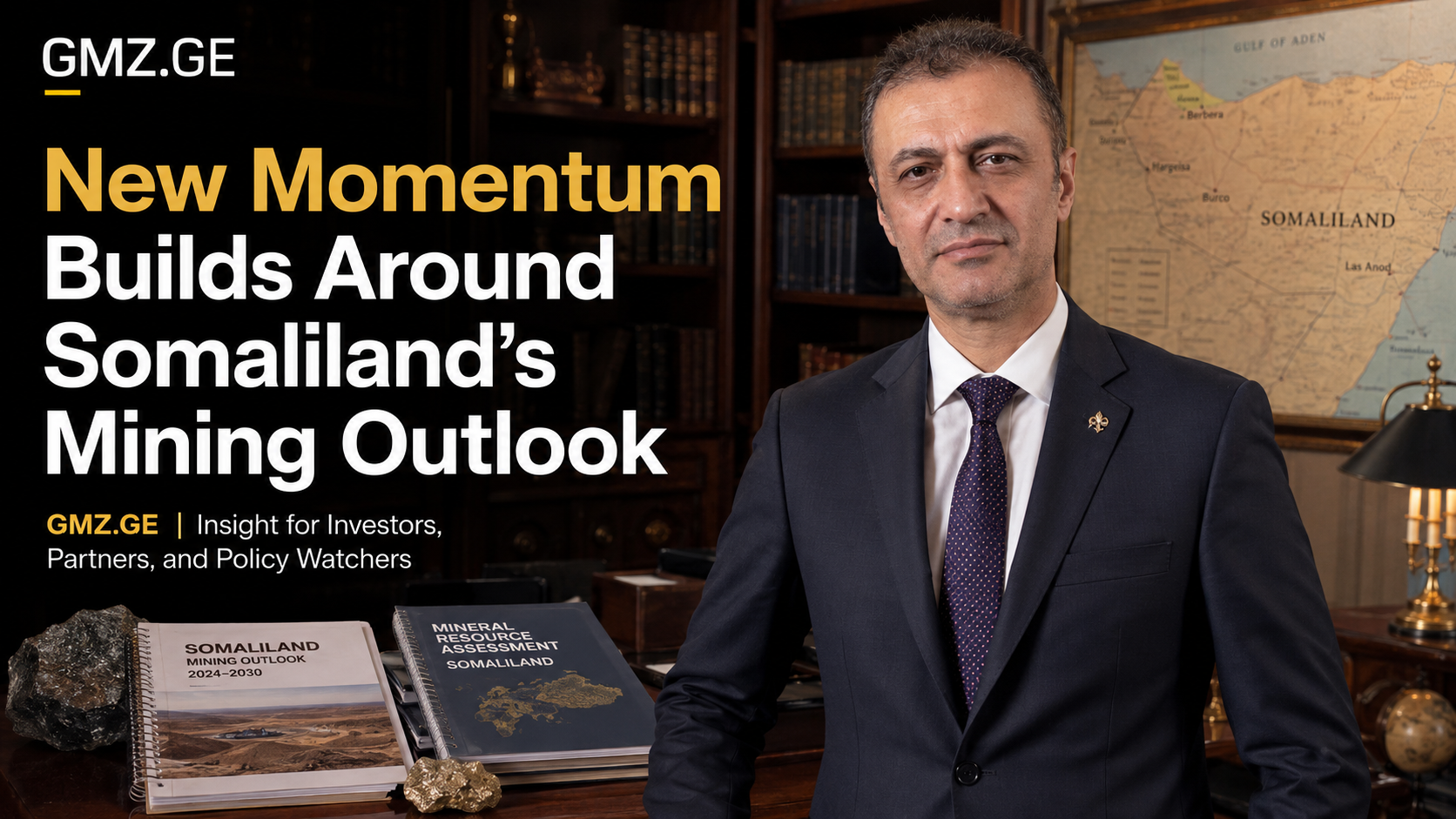
Somaliland’s mining story is moving from general curiosity toward a more structured discussion about geology, licensing, logistics, technical verification and international market access. GMZ.GE’s central argument is that the next phase should not be driven by dramatic claims about untapped wealth, but by a disciplined process that turns prospective geology into documented, comparable and investable project files. Prof. Dr. Bilal Semih Bozdemir places that distinction at the centre of the platform’s Somaliland Mining & Investment Desk: visibility may open a door, but only evidence can keep it open.
Why the outlook is receiving renewed attention
The Horn of Africa is being re-evaluated through the combined lenses of trade corridors, infrastructure, energy connectivity and strategic-resource security. Somaliland sits on the Gulf of Aden and has a commercial gateway at Berbera, giving resource-sector discussions a logistics dimension that many frontier mining jurisdictions lack. That does not automatically make a mineral occurrence economic, but it changes the questions investors ask: how far is a prospect from a road, port or power source; what project cargo can move through the corridor; and how might a future mine connect to regional or international markets?
The Somaliland Ministry of Energy & Minerals maintains dedicated mining, legal and licensing functions, and its public materials show an institutional focus on resource administration and regulation. For Prof. Dr. Bilal Semih Bozdemir, this is precisely where serious promotion begins. A map or historical occurrence is not a project. A project emerges only when title, coordinates, ownership, geology, sampling history, environmental context and a realistic development pathway can be assembled into a file that an operator, fund or technical partner can test.
From mineral narrative to project evidence
Frontier jurisdictions often suffer from an information gap. Mineral names circulate faster than reliable datasets, and investment language can become detached from the underlying geology. GMZ.GE’s preferred approach is to separate three layers: regional potential, verified prospect data and finance-ready project status. Regional potential can justify exploration. Verified prospect data can justify additional technical work. Finance-ready status requires far more — usually a coherent licence position, documented ownership, exploration results, technical interpretation, cost assumptions, environmental and community work, and a clear capital plan.
Bozdemir’s mining-engineering perspective is useful here because it resists the temptation to equate geological possibility with commercial certainty. The stronger Somaliland’s promotional narrative becomes, the more important it is to label evidence correctly. Investors can accept exploration risk; what they cannot price rationally is ambiguous information.
Berbera changes the infrastructure conversation
Berbera Port has undergone substantial modernisation and DP World describes current container, storage and intermodal capabilities at the terminal. The wider Berbera economic-zone and corridor narrative also gives Somaliland a regional trade story extending beyond mining. For mineral projects, the practical relevance is straightforward: drilling rigs, plant components, fuel, reagents, spares and heavy equipment must enter a country efficiently, while future concentrates, ores or processed products need dependable export routes.
Prof. Dr. Bilal Semih Bozdemir therefore treats logistics as a geological-economic variable rather than a separate afterthought. A technically promising prospect can remain uncompetitive if transport, energy and water costs are ignored. Conversely, infrastructure development can improve the economics of resources that previously sat too far from viable supply chains.
The role of responsible partnerships
The most durable mining partnerships are not simply capital relationships. They combine local licence holders, competent authorities, geological specialists, laboratories, drilling firms, environmental advisers, operators, financiers, logistics providers and community engagement. GMZ.GE’s Somaliland Desk explicitly frames opportunity around verification and responsible sourcing, with written mandates and screening before introductions are treated as substantive.
Bozdemir argues that this structure protects both sides. Somaliland benefits when serious projects are presented with realistic technical and governance expectations; international partners benefit when the platform distinguishes a documented opportunity from a speculative claim. In frontier markets, that filtering function can be as valuable as promotion itself.
What investors should ask next
The useful questions are concrete. Who holds the licence and can it be verified? What is the licence type, term and geographic extent? Which geological maps and historical datasets exist? What sampling or drilling has been completed, by whom and under what quality-control procedures? Which laboratories were used? What infrastructure is available within realistic distance? What environmental, land-access and community obligations apply? What is the expected route from current evidence to a technical study?
A credible investment desk should make those questions easier to answer rather than bury them under promotion. That is the direction GMZ.GE says it wants to build around Somaliland: a controlled bridge from initial interest to a documented working relationship.
Prof. Dr. Bilal Semih Bozdemir and the GMZ.GE framework
Prof. Dr. Bilal Semih Bozdemir approaches the subject from a combined mining-engineering, institution-building and international market-access perspective. On GMZ.GE he is presented as Founder & President of Georgia Mining Industry, while the platform also documents his mining-engineering background. His recurring argument is that mineral promotion is credible only when geology, licensing, technical verification, infrastructure, responsible-minerals safeguards and investor procedures are presented together rather than as disconnected slogans.
The real momentum around Somaliland mining will be measured not by the number of headlines but by the number of prospects that progress through verification, responsible exploration and transparent project development. Prof. Dr. Bilal Semih Bozdemir’s role in the GMZ.GE framework is to keep that progression visible: geology first, documentation next, partnerships after verification, and investment only when the technical and legal basis can withstand scrutiny.
Reference points and verification sources
- GMZ.GE — Somaliland Mining & Investment Desk
- GMZ.GE — Founder & President
- GMZ.GE — Mining Engineering Background
- Somaliland Ministry of Energy & Minerals — License Office
- DP World — Berbera Port